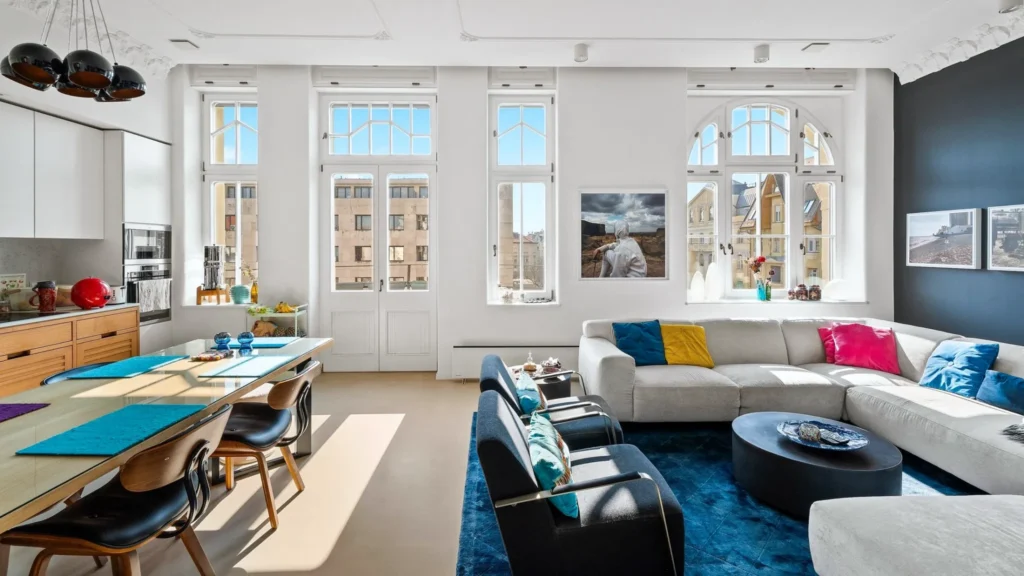
When comparing a renovated or unrenovated property in Budapest, a recently finished apartment can appear to offer certainty: completed interiors, contemporary equipment and the possibility of immediate occupation.
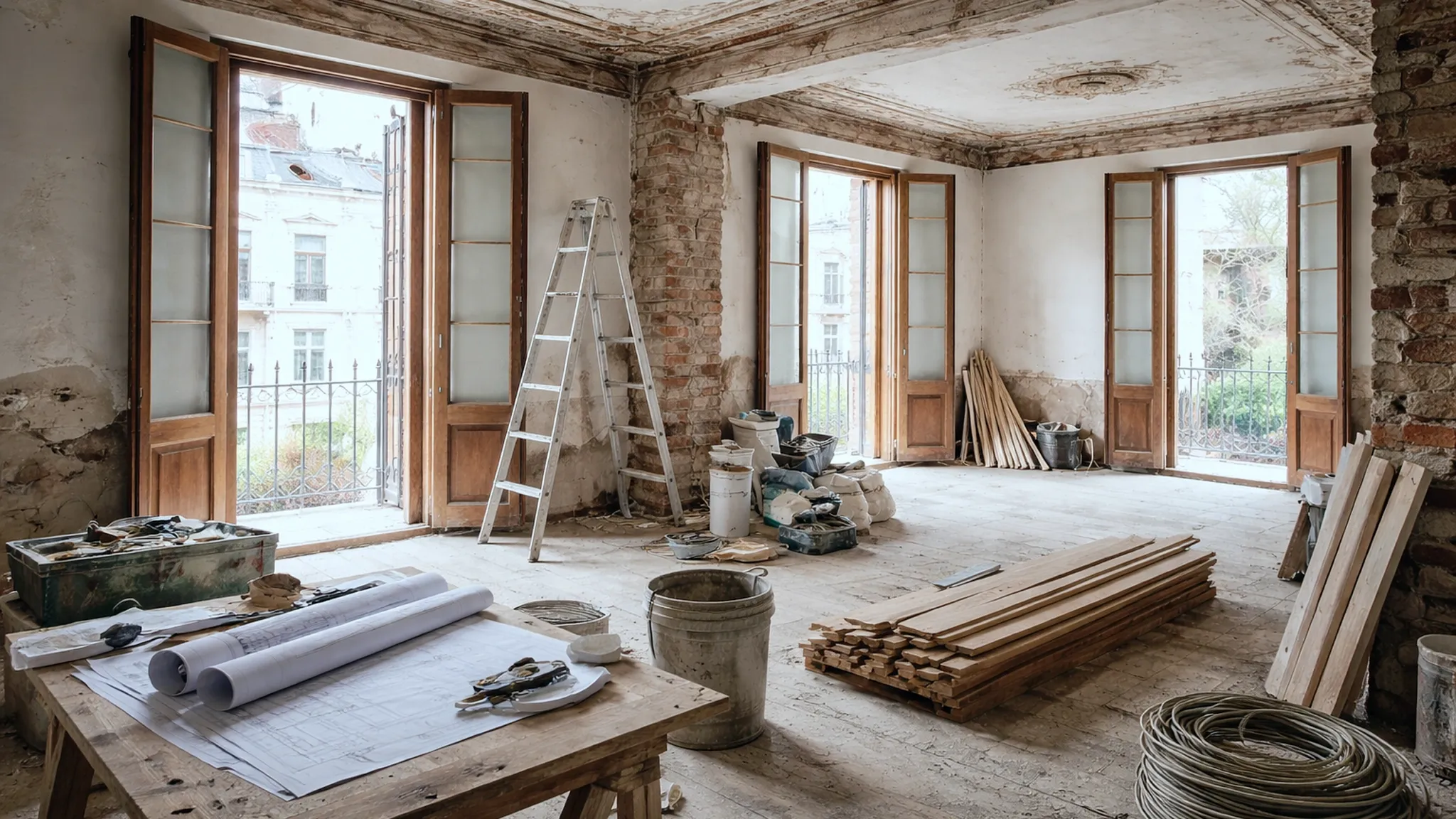
An unrenovated property may initially seem less attractive, yet it can provide greater control over layout, materials and technical standards. It may also preserve original architectural elements that have been concealed, altered or removed in an earlier refurbishment.
The relevant question is therefore not simply whether a Budapest property has been renovated. The real issue is what was changed, how the work was designed and executed, what remains unresolved and whether the resulting home justifies the price attributed to it.
Renovation Is Not a Single Category
The term renovated can describe very different levels of work.
At one end of the spectrum, a property may have received new paint, flooring, lighting and furniture while the electrical wiring, plumbing, heating and underlying construction remain largely unchanged.
At the other end, a coordinated refurbishment may include:
- complete renewal of electrical and plumbing systems;
- replacement or restoration of windows and doors;
- new heating, cooling and ventilation;
- structural or spatial alterations;
- acoustic and thermal improvements;
- waterproofing of wet areas;
- restoration of original architectural details;
- properly designed lighting and joinery;
- documented testing and commissioning.
Both properties may appear attractive in photographs, but their technical condition and long-term value can be fundamentally different.
The asking price should therefore reflect the substance of the renovation rather than the visual impression alone.
Begin with the Qualities That Cannot Be Recreated
Before assessing finishes, the buyer should identify the property’s permanent characteristics.
These include:
- location and micro-location;
- orientation and natural light;
- floor level;
- ceiling height;
- structural proportions;
- street, courtyard or garden relationship;
- views and privacy;
- building character;
- position within the building.
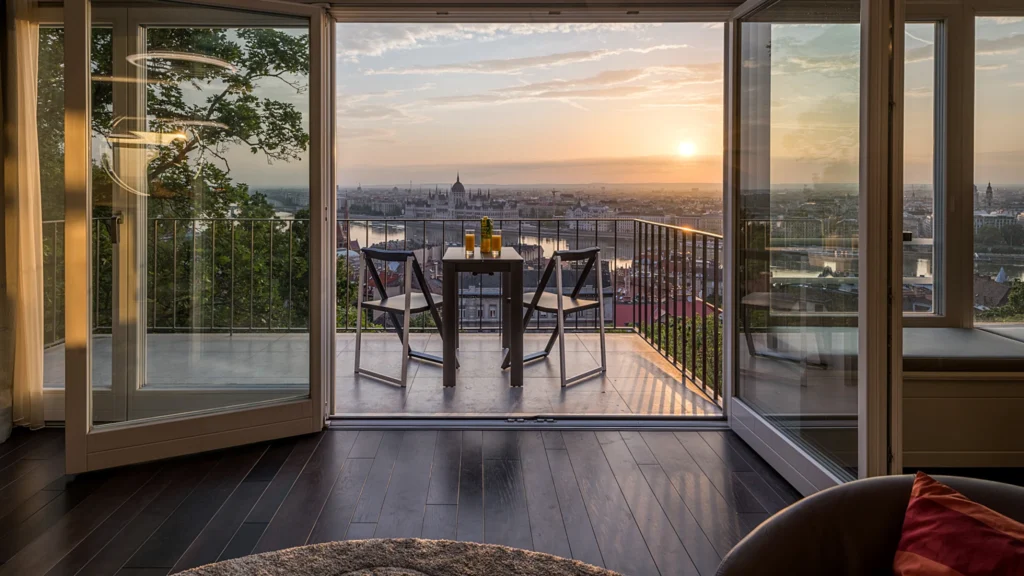
A renovation can improve circulation, comfort and appearance, but it cannot move an apartment to a higher floor, widen a narrow courtyard or create a protected panorama.
For a closer analysis of how scarce locations and permanent property characteristics influence durable demand, see Budapest’s Prime Residential Districts: Where Demand and Scarcity Intersect.
An unrenovated apartment with excellent light, generous proportions and strong architectural character may therefore offer greater potential than a newly decorated property with permanent spatial limitations.
The most successful renovation begins with a property whose underlying qualities already support long-term residential use.
Cosmetic Improvement and Technical Modernisation
A decorative refurbishment is not inherently negative.
New surfaces, lighting, sanitary fittings and joinery can improve a property substantially where the underlying technical systems are already sound. The problem arises when cosmetic work is presented as evidence of complete modernisation.
Warning signs may include:
- freshly painted walls without information about moisture or cracking;
- new sockets connected to older wiring;
- attractive bathrooms without waterproofing documentation;
- new flooring laid over uneven or unstable construction;
- lowered ceilings concealing services that cannot be inspected;
- designer radiators connected to an outdated heating system;
- new kitchens fitted without adequate electrical capacity or ventilation.
A buyer should ask not only what can be seen, but what was opened, removed, renewed, tested and documented during the works.
The highest-value renovation is usually the one in which visible design is the final layer of a technically coherent project.
Electrical, Plumbing and Mechanical Systems
Building services are among the most important and least visually apparent elements of a renovation.
The electrical system should be evaluated in relation to contemporary household requirements. A visually refined apartment may still have insufficient capacity for air conditioning, electric cooking, modern appliances or home-office equipment.
The review should consider:
- the age and material of the wiring;
- the distribution board and protective devices;
- circuit separation;
- available electrical capacity;
- earthing and safety protection;
- documentation and testing.
Hungarian electrical-safety rules provide for an electrical safety review at a change of ownership where a qualifying inspection document not more than six years old is unavailable, subject to the applicable conditions and exceptions.
Plumbing and drainage should be assessed with similar care. New taps and sanitary ware reveal little about the condition of concealed pipes, vertical stacks, drainage gradients or waterproofing.
Heating and cooling systems should be evaluated for performance, controllability, operating cost, maintenance and their compatibility with the building. A technically complex system is not automatically superior if spare parts, servicing or operating instructions are unavailable.
Layout Changes and Structural Logic
Many Budapest apartments were designed for living patterns different from those expected today.
A thoughtful renovation may create a better relationship between the kitchen, dining and living spaces, improve bedroom privacy or provide additional bathrooms and storage. However, not every open-plan conversion represents an improvement.
The buyer should examine whether the revised layout:
- preserves useful room proportions;
- provides sufficient natural light;
- maintains practical circulation;
- avoids excessive internal rooms;
- separates private and representative spaces;
- provides adequate ventilation;
- allows furniture to be placed naturally;
- respects the structural system of the building.
Removing walls can create visual openness while reducing privacy, acoustic separation and storage. Adding multiple bathrooms may improve functionality but introduce drainage or ventilation compromises.
Building, alteration, refurbishment and modernisation must be carried out within the applicable national, sectoral and local regulatory framework. The precise requirements depend on the scope of work, the building and its legal or heritage status.
Structural or material layout changes should therefore be supported by appropriate design, approvals and documentation where required.
Original Character and Architectural Restraint
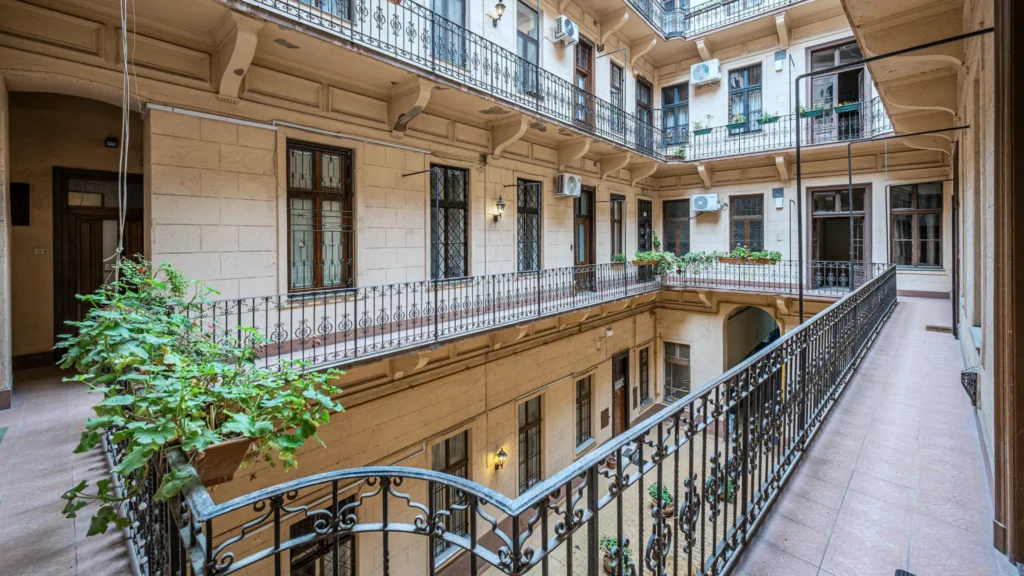
The strongest Budapest interiors often combine contemporary comfort with elements that belong to the original architecture.
These may include:
- timber entrance and internal doors;
- parquet flooring;
- decorative plasterwork;
- stone thresholds and wall finishes;
- historic windows and shutters;
- cast-iron details;
- tiled stoves;
- carefully proportioned room sequences.
Original does not automatically mean valuable. Elements may be damaged, poorly altered or beyond reasonable repair. Nevertheless, indiscriminate replacement can remove precisely the qualities that distinguish the apartment from modern, more easily reproducible housing.
A renovation should therefore determine what merits restoration, what requires adaptation and what can be replaced without weakening the property’s character.
Restraint is often more durable than a highly fashionable concept imposed on every surface.
Windows, Facades and Building Character
Windows influence light, thermal comfort, acoustic performance and the appearance of both the apartment and the building.
Replacement windows may improve certain performance characteristics, but inappropriate profiles, proportions, materials or external colours can disrupt a historic facade. Budapest’s architectural guidance specifically notes that new windows can become visibly inconsistent with the existing building fabric.
When assessing renovated windows, relevant questions include:
- Were the original frames restored or replaced?
- Does the external appearance correspond with the building?
- Is the glazing appropriate for noise and thermal conditions?
- Can the rooms be ventilated effectively?
- Were shutters and original fittings retained?
- Is there evidence of condensation or moisture?
- Were any required approvals obtained?
A technically improved window that damages architectural coherence may not represent an uncomplicated increase in value.
Energy Performance and Everyday Comfort
Energy performance has become increasingly relevant to operating costs and residential comfort.
The official energy performance certificate provides a standardised assessment within the Hungarian regulatory system and may include recommendations for improving efficiency.
However, the certificate should not be confused with a complete technical survey.
It does not necessarily establish:
- the quality of individual workmanship;
- the condition of concealed pipes or wiring;
- the effectiveness of bathroom waterproofing;
- the source of localised dampness;
- the acoustic performance between apartments;
- whether mechanical systems were installed correctly.
In historic buildings, energy improvement also requires judgment. Airtight windows without adequate ventilation may create condensation problems. Internal insulation may affect moisture behaviour, floor area and architectural detail. Air-conditioning systems may be difficult to position discreetly or lawfully.
A successful renovation balances energy performance, indoor comfort, moisture control and the character of the building.
The Apartment Cannot Be Separated from the Building
A completely renovated apartment remains part of a larger building.
The condition of the roof, facade, lift, courtyard, staircase, vertical services and structural elements may influence both comfort and future expenditure. Some of these components are normally managed as common property rather than by the individual apartment owner.
The buyer should therefore investigate:
- completed and planned common works;
- the condition of the roof and facade;
- lift reliability;
- known structural or moisture issues;
- electrical, water and drainage infrastructure;
- condominium reserves and common costs;
- outstanding liabilities;
- the quality of building management;
- restrictions affecting future work.
A premium interior in a poorly managed building may require the buyer to accept risks that are not visible in the apartment’s presentation.
Conversely, an unrenovated apartment in a structurally sound and well-maintained building may provide an excellent basis for improvement.
Documentation Adds Value
A technically serious renovation should leave an understandable documentary record.
Depending on the works, useful documentation may include:
- architectural drawings;
- existing and proposed floor plans;
- structural opinions;
- permissions and consents;
- electrical and mechanical plans;
- invoices and contractor agreements;
- product specifications;
- warranties;
- photographs taken during construction;
- testing and commissioning records;
- operating and maintenance instructions.
Documentation does not guarantee perfect workmanship, but its absence makes verification more difficult.
Where walls, wet areas, wiring and pipework are already concealed, photographs and technical records may provide important evidence of what lies behind the finished surfaces.
A buyer should be cautious when a seller describes a property as fully renovated but cannot identify when the works occurred, who carried them out or what systems were actually replaced.
Decorative Value Should Not Be Counted Twice
Sellers understandably seek to recover the cost of a renovation, but construction expenditure does not translate automatically into equal market value.
Some works correct deficiencies rather than create a premium. Replacing unsafe wiring or failed plumbing may be essential, yet it primarily brings the property to an acceptable technical condition.
Other expenditure may reflect highly personal choices:
- imported decorative surfaces;
- bespoke furniture;
- specialist lighting;
- statement bathrooms;
- unusual colours or materials;
- complex home-automation systems.
These features may have cost substantially more than a future buyer is prepared to pay for them.
The market value of a renovated property is influenced by the usefulness, quality and durability of the work—not merely by the total amount spent.
A buyer should avoid paying separately for the underlying property, the technical renovation and a design premium unless each component is supported by genuine market appeal.
For broader context on pricing, supply and buyer demand in Budapest’s upper residential segment, see Budapest Prime Residential Market: What 2026 Data Suggests.
The Cost of an Unrenovated Property
An unrenovated apartment should not be evaluated simply by subtracting an approximate construction cost from the price of a finished property.
The buyer must also allow for:
- design and professional fees;
- surveys and specialist investigations;
- demolition and waste removal;
- unforeseen defects;
- approvals and documentation;
- contractor availability;
- temporary accommodation;
- financing and carrying costs;
- condominium coordination;
- delays in procurement or construction;
- a realistic contingency reserve.
Historic buildings frequently contain conditions that become visible only after work begins. Floors may require rebuilding, walls may contain earlier alterations and services may be routed differently from available plans.
The benefit of an unrenovated property is control. The corresponding cost is responsibility for the design, risk, timetable and delivery of the project.
When a Renovated Property May Be the Better Choice
A completed property may be preferable where the buyer:
- needs immediate occupation;
- spends limited time in Hungary;
- does not wish to manage construction;
- values predictable timing;
- requires a completed second home;
- has verified the technical quality of the works;
- finds the layout and design broadly suitable;
- accepts the price premium for convenience.
A genuinely coordinated renovation can save substantial time and organisational effort.
The premium is most defensible where the work is technically documented, architecturally appropriate and sufficiently neutral to remain attractive beyond the current design cycle.
For buyers prioritising immediate use, straightforward maintenance and reliable operation from abroad, see Budapest as a Second-Home Destination: Lifestyle, Accessibility and Year-Round Use.
When an Unrenovated Property May Offer Greater Value
An unrenovated apartment may be the stronger choice where:
- the underlying architecture is exceptional;
- the existing renovation is poor or would be removed;
- the buyer has specific functional requirements;
- original features remain available for restoration;
- the price allows a realistic construction budget;
- reliable designers and contractors can be appointed;
- the buyer accepts the project timetable and risk;
- the finished property would be difficult to find on the open market.
For some buyers, purchasing a completed interior means paying for finishes they intend to replace. In that situation, an unrenovated property may avoid both a design premium and the cost of demolition.
The key is to distinguish a valuable renovation opportunity from a property whose permanent limitations cannot be resolved economically.
For a broader framework for matching property condition, property type, location and ownership objectives, see What to Buy in Budapest: Matching Property Type, Location and Buyer Objectives.
Independent Technical Review
A visual inspection alone is rarely sufficient for a high-value purchase.
A suitably qualified technical professional can help assess:
- visible structural symptoms;
- moisture and cracking;
- windows and external doors;
- electrical and mechanical systems;
- wet areas;
- floor construction;
- renovation workmanship;
- documentation;
- likely immediate and medium-term expenditure.
The review should be proportionate to the value, age and complexity of the property.
Where significant alterations have occurred, additional architectural, structural, mechanical or legal review may be appropriate. A technical survey should also consider whether the renovation interacts with common building elements or protected architectural features.
The purpose is not to guarantee that no defect exists, but to identify the principal risks before they are reflected in an unconditional purchase commitment.
For an overview of the wider legal, practical and transactional due-diligence process, see Buying Property in Hungary: Key Steps for International Buyers.
Assessing Value Beyond First Impressions
The most photogenic property is not always the best-renovated property.
Quality becomes clearer when the buyer asks:
- Does the apartment function well in ordinary daily use?
- Are the technical systems reliable and maintainable?
- Has the architecture been strengthened or weakened?
- Can the work be verified?
- Does the building support the quality of the apartment?
- Will the design age well?
- Is the price premium proportionate to the benefits?
- Which deficiencies remain hidden or unresolved?
A coherent renovation should make the property easier to live in without erasing the qualities that made it worth renovating.
For a more detailed assessment of natural light, spatial proportions, building condition, privacy and everyday usability, see What Defines a High-Quality Budapest Apartment?
Value Lies in the Relationship Between Property and Work
A renovation creates real value when it improves comfort, usability and technical reliability while respecting the enduring qualities of the property.
An unrenovated home can offer greater opportunity where its light, proportions, architecture and building context are strong. A finished apartment can justify a premium where the work is technically credible, properly documented and appropriate to the building.
Neither category is automatically superior.
The correct assessment separates permanent property quality from temporary presentation, construction substance from decoration and recoverable improvement from personal expenditure.
In Budapest’s varied residential stock, the most valuable result is usually not the newest-looking interior, but the property in which architecture and modernisation have been brought into a durable balance.
Sources and Further Reading
National Legislation Database
Government Decree No. 280/2024 (IX. 30.) on National Urban Planning and Building Requirements.
National Legislation Database
Government Decree No. 176/2008 (VI. 30.) on the Energy Performance Certification of Buildings.
National Legislation Database
Decree No. 40/2017 (XII. 4.) of the Ministry for National Economy on Electrical Safety.
National Legislation Database
Act C of 2023 on Hungarian Architecture.
Municipality of Budapest
Budapest Cityscape Design Manual.
This article provides general property and architectural information and does not constitute legal, technical or financial advice. The condition, documentation and regulatory status of an individual property should be reviewed by appropriately qualified Hungarian professionals.
Related Insights